Differences in the number of blades of large industrial fans
The difference in the number of blades of large industrial fans is mainly reflected in their design purpose, wind effect and energy efficiency ratio.
Generally speaking, industrial fans with more blades, such as six blades or more, often pay more attention to the softness and uniform distribution of wind in their design. When these fans are running, they can produce more delicate airflow, reduce air disturbance, and make the working environment more comfortable. They are usually used in places with high requirements for air circulation, such as precision manufacturing workshops, laboratories, etc., to ensure air quality and comfort.
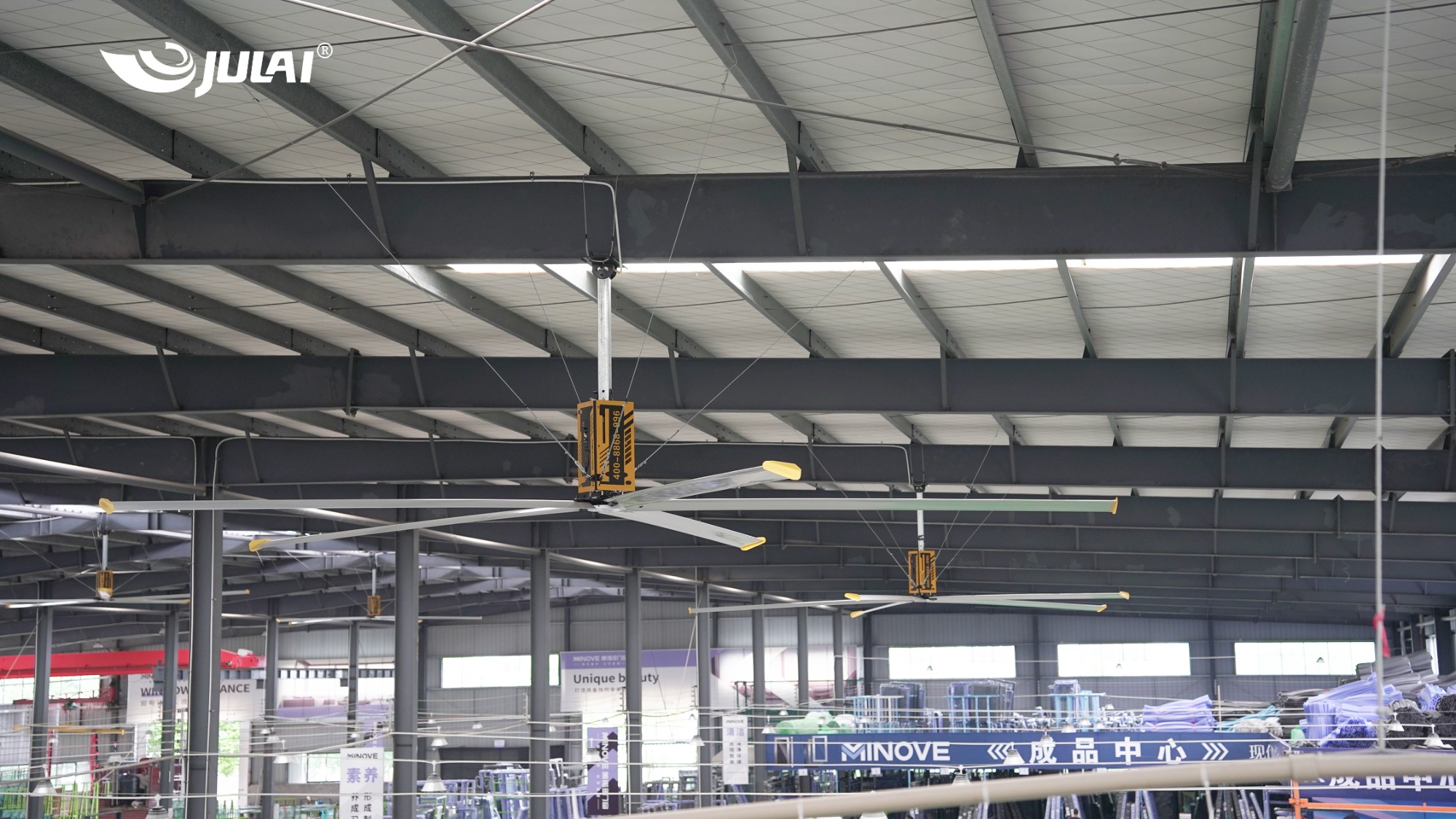
However, industrial fans with fewer blades, such as three blades or less, focus more on efficient output and energy saving of wind. The blade design of this type of fan is usually wider, which can generate stronger wind at lower energy consumption, and is suitable for large spaces that require rapid cooling or ventilation, such as warehouses, gymnasiums, etc. Although the wind may be relatively direct and strong, a more comfortable air circulation effect can also be achieved through reasonable layout and regulation.
In addition, the different number of blades will also affect the noise level and maintenance cost of industrial fans. Generally speaking, fans with more blades produce relatively less noise during operation, but maintenance costs may increase due to the complexity of the blade structure. On the contrary, fans with fewer blades may be slightly inferior in noise control, but maintenance is relatively easier.
 Julai to Attend the 140th Canton Fair — HVLS Large Ceiling Fans for Energy‑Saving Ventilation
 JULAI to Attend the 23rd China-ASEAN Expo | Sincere Invitation to Global Partners
 Industrial Large Fans: The Practical Choice for Factory Ventilation and Cooling
 Why are super-large industrial fans chosen for cooling in large-scale spaces?

 English
  日本語
日本語  Deutsch
  Français
  Español
  Русский
  Português
  繁體中文
繁體中文  Italiano
  한국어
한국어  ဗမာ
ဗမာ  ไทย
ไทย  Tiếng Việt
  Ελληνικά
  नहीं।
नहीं। 

