1.Key Factors Influencing Coverage Area:
①Fan Diameter:
7.3m diameter: Covers 1,200–2,000 m² (ideal for warehouses).
6.1m: 800–1,000 m²
5.5m: 500–900 m². Larger diameters deliver broader airflow with fewer units.
②Installation Height
6-8 meters height: The wind pressure is stronger and the coverage area is smaller, so the fan density needs to be increased.
9–13m height :maximizes coverage (+20–30%) for uniform airflow.
>14m heights :Lower the installation height or use an extension pole, otherwise the coverage effect will be weakened.
③Layout & Environment:
Ground obstacles (such as equipment and partitions) will limit the diffusion of airflow, and the number of fans needs to be increased.
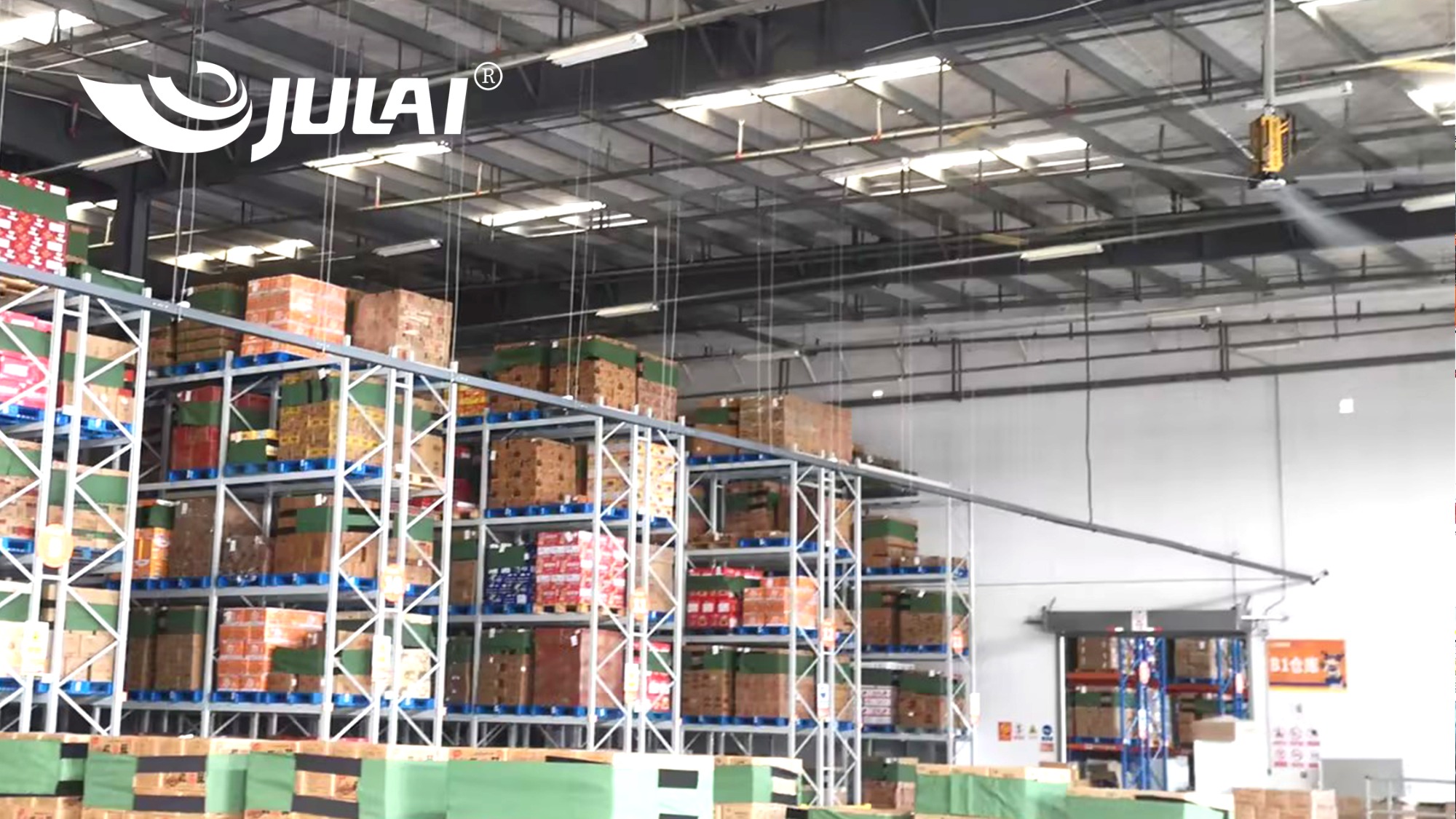
Open space can reduce the number of fans. For example, a 7.3-meter fan can cover 1500-2000㎡ when there is no obstruction.
2. The Math Simplified:
Theoretical Formula: Coverage area = π × R² (R = effective radius). Example: JULAI FANS KFseries 7.3m fan (radius ≈25m) covers ~1,963 m². Apply an 80% efficiency factor for real-world adjustments.
Multi-Fan Layout: The theoretical coverage area of three fans is three times that of a single fan, but this needs to be reduced appropriately due to overlap.
3x 7.3m fans can cover ~2,500–3,000 m² with 20–30m spacing to avoid turbulence.
3. Practical Recommendations:
1️⃣Selection by application area:
For 2,000–3,000 m²: 3x 7.3m fans.
For 1500-2000㎡: 2-3 x 6.1m fans.
Below 1200㎡: one 5.5m or smaller diameter fan.
2️⃣Special scene adjustment
High-heat/humidity areas: Opt for higher airflow models (e.g., RTF-CF-7E: 13,800 m³/min).
Complex layouts: Add 10–20% more units to eliminate dead zones.
3️⃣Importance of professional assessment
It is recommended to contact the supplier for on-site assessment and customize the solution based on the specific height, obstacles and ventilation requirements.
4. Case Study: A 2,500 m² steel-structured facility (10m height, no obstacles):
1x 7.3m fan ≈1,440 m² (after 80% adjustment).
Solution: 2 fans spaced 25–30m apart.
✅ Why Partner with Experts? Brands like JULAI FANS offer tailored assessments to factor in height, obstacles, and environmental needs. KFseries HVLS-DT2573 model exemplifies precision in balancing coverage and energy efficiency.
Pro Tip: Always validate calculations with on-site evaluations for optimal results.
 Julai to Attend the 140th Canton Fair — HVLS Large Ceiling Fans for Energy‑Saving Ventilation
 JULAI to Attend the 23rd China-ASEAN Expo | Sincere Invitation to Global Partners
 Industrial Large Fans: The Practical Choice for Factory Ventilation and Cooling
 Why are super-large industrial fans chosen for cooling in large-scale spaces?

 English
  日本語
日本語  Deutsch
  Français
  Español
  Русский
  Português
  繁體中文
繁體中文  Italiano
  한국어
한국어  ဗမာ
ဗမာ  ไทย
ไทย  Tiếng Việt
  Ελληνικά
  नहीं।
नहीं। 

