Can HVLS large fans save costs?
HVLS large fans in factories can significantly reduce operating costs. Their core advantage lies in achieving large-scale ventilation and cooling with low energy consumption, resulting in significant long-term economic benefits.
Comparing energy consumption, a traditional industrial fan draws approximately 0.75kW per unit and covers only 20-30 square meters. Energy-saving large fans, on the other hand, draw 2.2-3kW and cover 1,000-1,500 square meters. For example, a 1,000-square-meter workshop would require 30-50 traditional fans, each drawing 22.5-37.5kW. For the same area, a single energy-saving large fan can be used, consuming only 6%-13% of the power of a traditional solution. Operating for 8 hours daily can save 156-276 kWh of electricity. Calculated at an industrial electricity price of 1 yuan per kWh, this translates to a monthly (22-day) savings of approximately 3,432-6,072 yuan.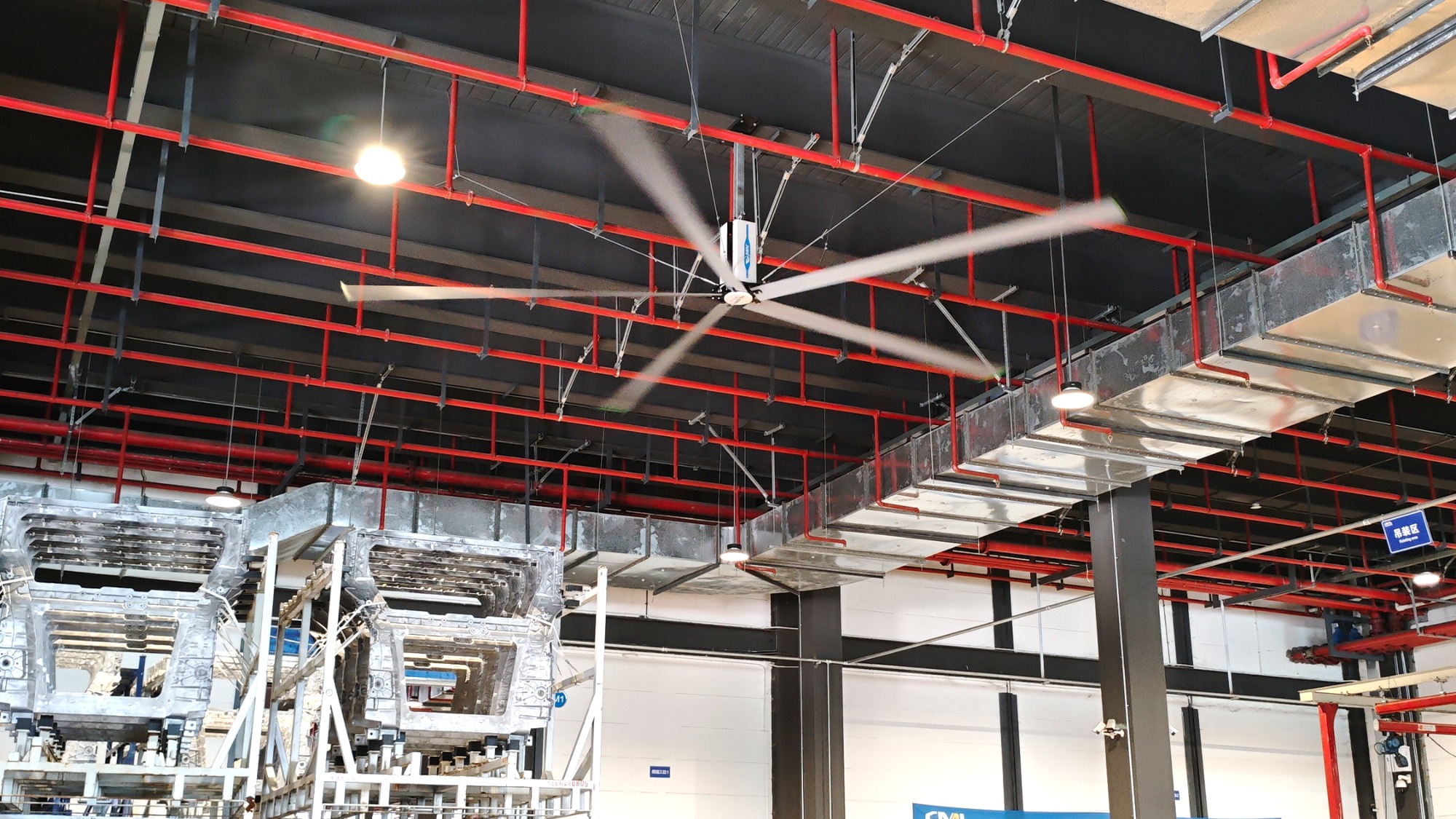
Improved cooling efficiency indirectly reduces other costs. Large energy-saving fans, by moving large volumes of air and creating wide-area airflow, lower the perceived body temperature by 3-5°C, reducing the frequency of air conditioning use in workshops. After using these fans, a machinery factory reduced air conditioning usage from six hours per day in summer to two, saving approximately 12,000 kWh of electricity per month. Furthermore, improved ventilation reduces equipment downtime due to high temperatures, lowering maintenance costs and improving production efficiency.
To maximize their benefits, large energy-saving fans in factories must be tailored to their application. They are most effective in workshops with heights over five meters and densely populated areas (such as assembly halls and storage areas), but are not suitable for smaller spaces or areas requiring localized, precise cooling (such as precision instrument workshops). A rational layout (e.g., installing one fan per 1,500 square meters) can avoid resource waste, ensure a balanced balance of energy savings and cooling, and truly achieve cost reduction and efficiency gains.

 English
  日本語
日本語  Deutsch
  Français
  Español
  Русский
  Português
  繁體中文
繁體中文  Italiano
  한국어
한국어  ဗမာ
ဗမာ  ไทย
ไทย  Tiếng Việt
  Ελληνικά
  नहीं।
नहीं। 


 Julai to Attend the 140th Canton Fair — HVLS Large Ceiling Fans for Energy‑Saving Ventilation
 JULAI to Attend the 23rd China-ASEAN Expo | Sincere Invitation to Global Partners
 Industrial Large Fans: The Practical Choice for Factory Ventilation and Cooling
 Why are super-large industrial fans chosen for cooling in large-scale spaces?
