What Factors Affect the Cooling Effectiveness of Industrial Fans?
The cooling effectiveness of industrial fans is influenced by their performance, environmental conditions, and installation method, requiring multi-dimensional optimization to achieve efficient heat dissipation.
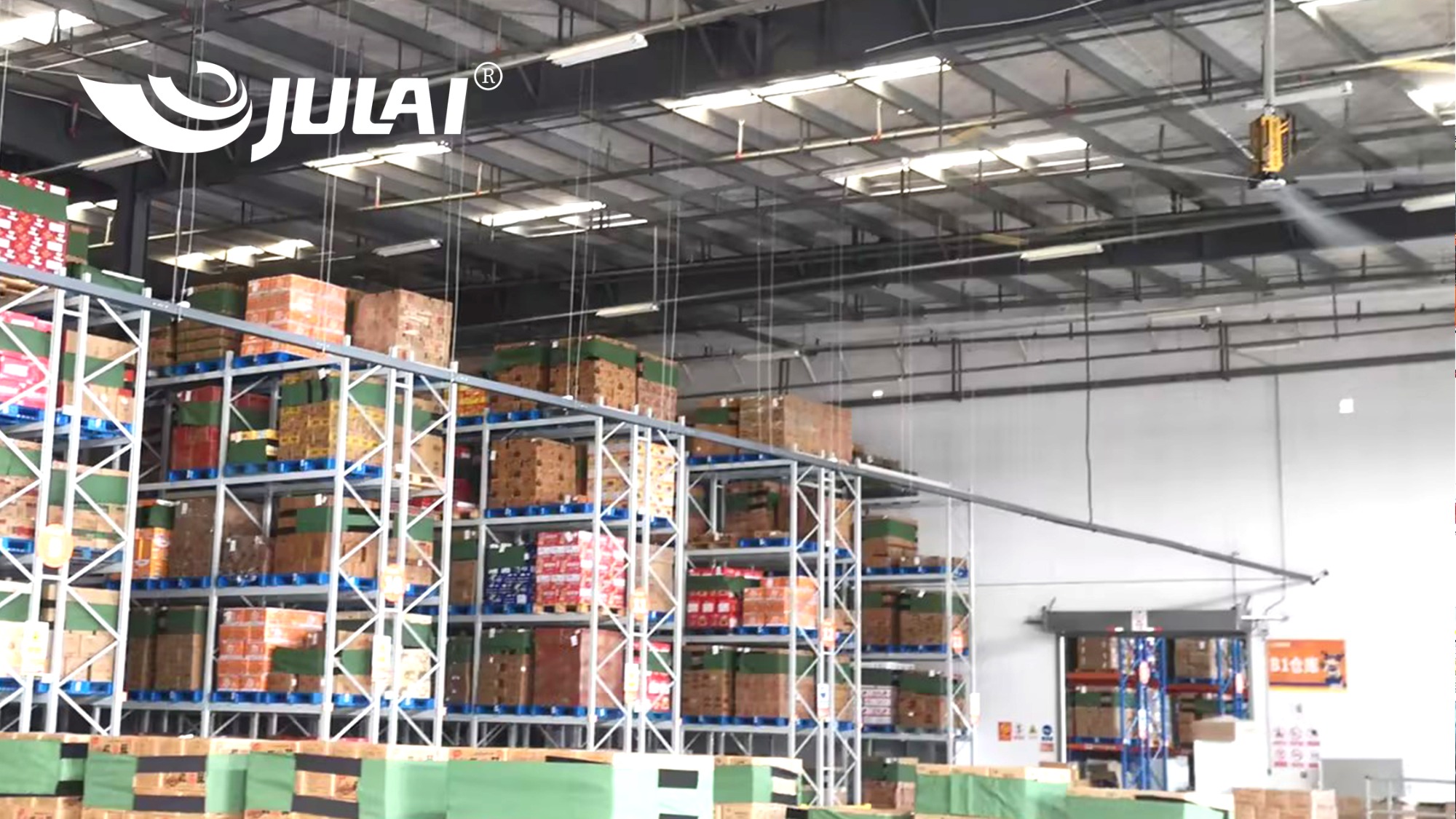
Core fan parameters are fundamental influencing factors. Blade diameter and speed directly determine air volume. For a large industrial fan with a diameter of 3-7.3 meters, a speed controlled at 40-60 rpm can create air circulation covering an area of 100-150 square meters. A suitable air speed is 2-3 m/s. Too low a speed will make it difficult to remove heat, while too high can cause discomfort or material dispersion. The blade angle must match the speed. A too low angle will not promote sufficient airflow, while a too high angle will increase the motor load, resulting in a decrease in actual air volume. The motor power must be compatible with the fan blade specifications. A 380V industrial motor typically has a power of 1.5-3 kW. Insufficient power will cause the speed to decrease due to overload, weakening the cooling capacity.
The characteristics of the ambient space significantly affect airflow diffusion. In enclosed workshops with poor ventilation, hot air can easily accumulate, creating a "greenhouse effect." Negative pressure fans should be used to promote air convection, achieving 10-15 air changes per hour to significantly improve cooling effectiveness. Large ceiling fans are suitable for tall spaces, leveraging the principle of air stratification to push cool air downward from above. For low-ceiling spaces, wall fans or station-mounted fans should be used to prevent airflow from being blocked by overhead obstructions. Ambient temperature and humidity also have an impact: In hot, dry environments, fans can reduce perceived temperature by 5-8°C by accelerating sweat evaporation. However, in high humidity, sweat evaporation is hindered, reducing the cooling effect by 30%-50%.
Obstacles and installation location determine the airflow path. Obstructions such as pillars or equipment within 1.5 meters of the fan can create shadowed areas, resulting in uneven cooling. Ensure the distance between the fan blades and obstructions is at least 1.2 times the fan diameter. The installation height should be adjusted according to the space: When the base of the ceiling fan is 4-5 meters above the ground, the airflow will evenly cover the work area. Too high, and the airflow speed will decrease when it reaches the ground, while too low can easily pose a safety hazard. Furthermore, the fan's mounting angle can direct airflow toward areas where people are active, improving cooling efficiency by 20% compared to horizontal installation.
The distribution of heat sources within the application scenario is also crucial. If a large amount of heat is dissipating in a workshop, the fan should be installed in the direction of the heat source, using airflow to direct heat toward the exhaust. In crowded areas, a "fan + mist" combination should be used to enhance cooling through water vapor evaporation. Dusty environments can reduce air speed due to dust accumulation on the fan blades, requiring regular cleaning and maintenance. In summary, the cooling efficiency of industrial fans must be maximized by matching fan parameters and optimizing the installation layout based on the specific scenario.

 English
  日本語
日本語  Deutsch
  Français
  Español
  Русский
  Português
  繁體中文
繁體中文  Italiano
  한국어
한국어  ဗမာ
ဗမာ  ไทย
ไทย  Tiếng Việt
  Ελληνικά
  नहीं।
नहीं। 


 Julai to Attend the 140th Canton Fair — HVLS Large Ceiling Fans for Energy‑Saving Ventilation
 JULAI to Attend the 23rd China-ASEAN Expo | Sincere Invitation to Global Partners
 Industrial Large Fans: The Practical Choice for Factory Ventilation and Cooling
 Why are super-large industrial fans chosen for cooling in large-scale spaces?
